Here is my Final preliminary outcome (as attached with my "How to shoot a conversation" post).
Below, is my "Preliminary Task: Continuity Editing" grade and teacher evaluation.
What are the rules for shooting a conversation?:
Deciding whether to use one or two cameras:
Why does this matter? Well, with a single camera, you will make four different takes:
1. Master shot
2. Character 1 medium shot
3. Character 2 medium shot
4. Pick ups
However, with two cameras, this is done in only 2 takes:
1. Master shot and pick ups with the first camera
2. Character 1 medium shot and Character 2 medium shot
How to Shoot a Conversation The image above helps establish the set up of a typical conversation scene; two subjects/characters, sitting opposite each other with a table in between them. It also helps to explain the shots listed for a single camera or, two.
Shot Variety:
A master shot is a single shot that includes the whole scene from start to finish and is a vital shot for shooting a conversation. Within a conversational scene, 4 master shots could possibly be taken from all four cameras within the image. This means filming from start to finish on character 1, then on character 2, a master shot of both subjects with the table between, and an establishing shot.
The medium shots of the character will include just the face and the shoulders within the frame, enabling the subjects expressions and gestures to come across clearly. The shot could be used when the character themselves is talking, or as a reaction shot to what the other is saying.
Pick ups are shots that fill in between the master, establishing and mid shots. These normally involve an extreme close up shot (ECU), possibly of the characters eyes, or an object such as a coffee cup, spoon or tapping pen. A bird's eye shot may also be included, to give an aerial shot and somewhat "layout" of the scene. For example on the table, we may see two glasses of water, and the characters reaching for them.
Over the shoulder shots may also be used to shoot a conversation. Within the frame the viewer will see the mid shot face on of one character, with the other characters back to the camera, as if the viewer is looking over their shoulder. This gives the feel that we are with the characters, receiving the information first hand.
Shot reverse shot is a technique where one character is shown looking at the other, who is often off screen, then the second character is shown looking at the first. When the camera cuts to each shot, the characters are sitting in opposite directions so the viewer automatically assumes that they are facing and talking to each other.
Continuity editing:
Continuity editing is important in any scene, however, because a conversation may take place in one location, the props and position of the characters must "flow" from one cut to the other in order for the scene to be believed as one whole conversation. This is where master shots come in handy! For example if you are filming a character, and their "side" of the conversation from start to finish, there is no need to cut and then pick up from where you stopped, eliminating any continuity errors. However, if a master shot is not used, you must be very careful to remember how a character finished, and how they must start, or where objects are in relation to the shot. An example situation:
A man is talking to a women and holding a cup of tea. The shot cuts to the women, then back to the man who is not holding a cup any more = bad continuity!
Example clips:
This conversation scene from "Risky Business" includes a shot reverse shot at the very start of the scene, establishing to the viewer that the two characters are opposite each other. A master shot is then used to show the position of each character and where they are in relation to the location. Both characters are standing but only the top half of their body is in frame. This is because if a long and extreme long shot was used, the viewer would lose the intimacy and focus upon the conversation and the characters reactions. Then, at 0.52, we see the characters move towards the camera; the angle slightly raised to film the character. This results in a new shot ( mid shot) created to add variety within the scene. Mid character shots and and over the shoulder shots are then used. The over the shoulder shot when the male character grabs the nurses collar makes the viewer focus upon the nurses reaction more than the physical grab, as we can only see the back of the male character and his action.
Again, with " Scrubs- JD and Elliot Get Back Together - "My Happy Place" from 1:25, a variety of over the shoulder shots, character mid shots, shot reversed shots, establishing shots are used. Only this time, a third character is introduced at the start and near the end of the scene (bringing them back to reality).
However!
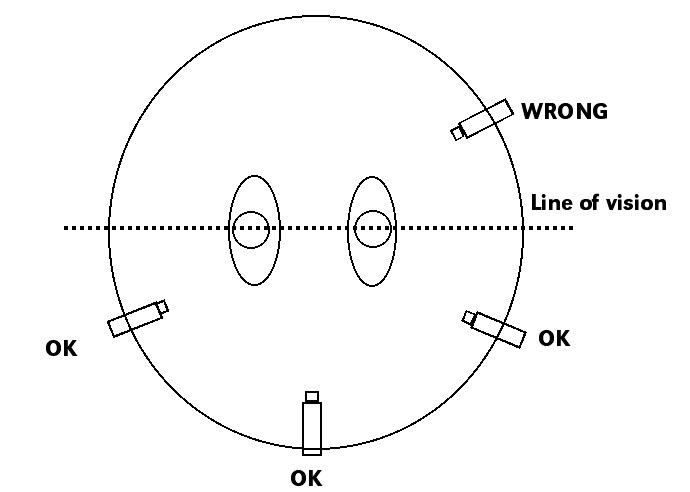
I included the above clips because both conform to the 180 degree rule. With a conversation, an imaginary line is drawn through the middle of both characters, expressed in the image. The camera can then go any where on that side of the line BUT not cross it! this is because if the camera crosses the line, the two characters will look like they are on opposite sides to what they were not, affecting continuity. In the first clip, a long table, wall and window signifies the barrier, and stops the camera from "crossing the line". However, the "Scrubs" clip conforms to the rule to a certain extent. This is because the rule is used between the two characters, in the dark. But, when the third character is in the scene, there are some over the shoulder shots from behind the third character ( 0:16 and 4:34), which "crosses the line" from the previous dark background scene. However, with more than two characters involved, it is hard to conform to the rule.
Breaking the 180 degree rule- The Shining:
As you can see, from this bathroom conversation scene from The Shining, Stanley Kubrick (director) clearly breaks the 180 degree rule. This is because at the start of the scene, the audience see the man in the red jacket on the left, and the butler-like man on the right near the sinks. However, at 0.19 the shot changes from a long shot to a mid shot, filmed from the other side of the characters. The camera has evidently "crossed the line" because the character with the red jacket is now on the right and the butler- like character on the left, even though they haven't physically moved positions. This is then reversed back to the original long shot at 2.07, then to the other side at 2.31, followed by a series of close up shots.
By deliberately breaking the rule, Stanley Kubrick creates confusion and disorientation; the music and characters physical emotions and actions contributing to an eery, uncomfortable tension. However, due to the genre of film, (horror) this rule break can be seen as acceptable, otherwise the audience would not feel confused and uncomfortable, which some might argue, is the point of a horror film!
Preliminary Conversation:
Below, is my Preliminary conversation along with story board, in which I acted, filmed part of, and edited. Before shooting, we as a group created individual story boards to help us with filming.

http://www.youtube.com/watch?v=1lyu1KKwC74
A link ( because of restricted VEVO content) to The Verve's music video "Bitter Sweet Symphony". Includes tracking, a variety of shots and the all important close ups of feet!
To make the perfect walking shots, certain rules, camera movements and shot must be taken into consideration.
Tracking and Panning:
http://www.youtube.com/watch?v=llLEXbcocuw
Above is the link to one of four YouTube videos. The clip is titled "The Inbetweeners-Malia Strip". Due to the content of the scene (Which is primarily walking) I am unable to directly show the footage. However, the link will take you to the YouTube Page, no hassle.
The scene starts with a long shot of the four characters walking. This enables all four characters to be within shot and also establish where they are. The seen is also slowed down ( with small, fast paced sections in between). Slowing the footage down creates a dramatic effect, as each movement is more prominent, bringing our focus upon the characters, against the busy, fast, party lifestyle of Malia. A series of mid shots are then created as three girls the is focused upon go past the characters. The mid shots, showing just the face and shoulders of two characters within the frame, clearly show their expressions, as well as a blurred Malia party background. Throughout, the characters are tracked backwards; a camera movement in which the camera follows or "tracks" the subject(s) at eye level, so the viewer continues moving with the subject. As this is to do with walking, this is an important movement in order to keep up! Another camera movement within the scene is side to side panning. This is when the camera is stationary but pans from left to right to establish more scenery that may be important to the plot, or possibly what the characters are looking at. In this case, at 0.37, there is a 360 degree pan from right to left, while still tracking backwards. This shows that a lot is going within the mise en scene, but also takes our focus of the characters, so as we come back, we witness their expressions to what we just followed.
Variety of Shots and Dissolve Transition:
Another video, this time from Monsters Inc, shows the monsters walking in to start their jobs, with the protagonist centre front. This particular walking scene displays a dissolve transition effect, resulting in an extreme long shot, long shot and medium shot. Including a variety of shots is a key factor towards a good walking shot! A dissolve transition, which occurs on the beat of the music,is used in order to condense time. This means that we don't see the characters walking the full length, saving screen time while also introducing us to the characters, and their serious faces.
180 Degree Rule:
http://www.youtube.com/watch?v=8tJoIaXZ0rw
Titled "500 Days of Summer - You Make My Dreams", for the same reason (content) as the first, I have provided the YouTube link.
This scene from 00.00 to 0.37 displays the 180 degree rule. The rule states that characters within a scene, once it is established, should have the same left-right relationship, in order to maintain continuity and stop confusion. An imaginary line is drawn and an axis connects the left end to the right end. This is where the camera can film. Therefore, from the link above, whenever we see the male character, he should be walking from the left to the right, which he does. However, if the rule is broken, it is known as "crossing the line", in which the characters could be seen as looking in the same direction as each other, or walking in the opposite direction to as before. The image below should explain:
Camera Angles and Shot Types Power PointWith original photographs and annotations.
Hi, I'm Megan Edwards and this is my Media blog.